
What Does the Wiring Actually Look Like?
Salesforce (CRM), ServiceNow (NOW), Workday (WDAY) — Part II

On February 5th, 2026, a woman named Fidji Simo stood in front of a room of reporters and described a dream she’d had at her previous job.
When Simo was the CEO of Instacart, she wanted to give her teams the best AI tools available. So she did what every enterprise executive does: she assessed hundreds of software vendors, selected the winners, and then spent months integrating each one into Instacart’s operations. The result? Every tool was excellent at its own thing, but none of them talked to each other. She had spent a fortune reinforcing the very silos she was trying to destroy.
Now Simo is the CEO of Applications at OpenAI. And the platform she unveiled that day - called Frontier - is her answer to the problem she couldn’t solve at Instacart. It is also, depending on who you ask, either the most significant architectural challenge to enterprise SaaS since the invention of the cloud, or a very expensive press release.
Two weeks ago, in The Vibe-Coded Enterprise, we argued that the “SaaSpocalypse” thesis - the idea that AI would allow companies to simply build their own Salesforce over a weekend - was nonsense. The people pricing that scenario into the market had never endured an enterprise software implementation. They had confused code with infrastructure. They were wrong.
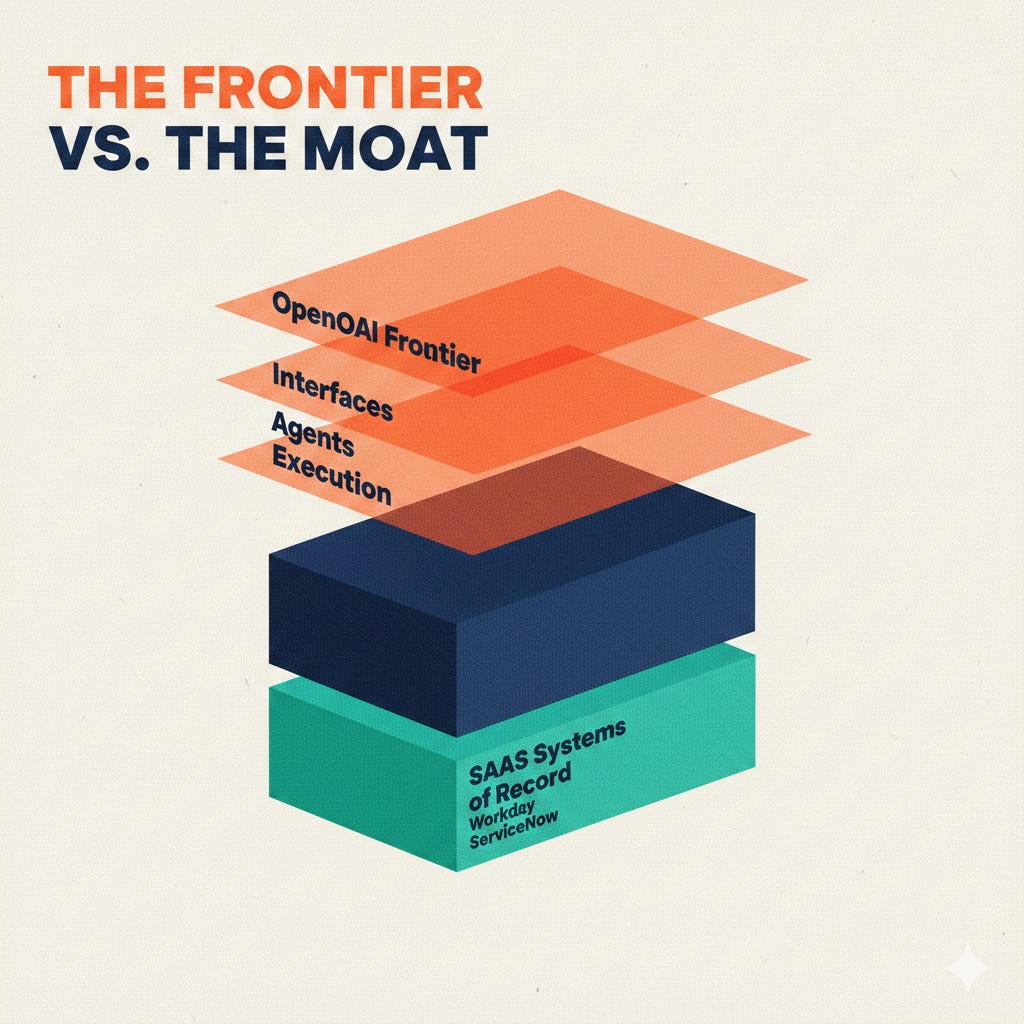
We stand by that argument, and this week we’ll focus on Open AI’s Frontier over Anthropic’s Claude Code and CoWork. Frontier isn’t proposing to replace code with code. It’s proposing something more subtle and, if it works, more consequential. It wants to sit on top of the enterprise stack and absorb the parts that matter most - the user relationship, the decision-making layer, the cross-system intelligence - while leaving the boring, regulated, legally liable parts exactly where they are.
To figure out whether that’s genius or fantasy, you have to stop thinking in abstractions. You have to look at the actual wiring inside an actual company. So that’s what we’re going to do.
The Three Kingdoms
Most enterprise technology commentary treats “SaaS” as a single category. It is not. Inside a large organisation, Salesforce, ServiceNow, and Workday occupy fundamentally different positions, serve different masters, and carry different levels of legal exposure.
Here is what the stack actually looks like for a Fortune 500 firm running all three:
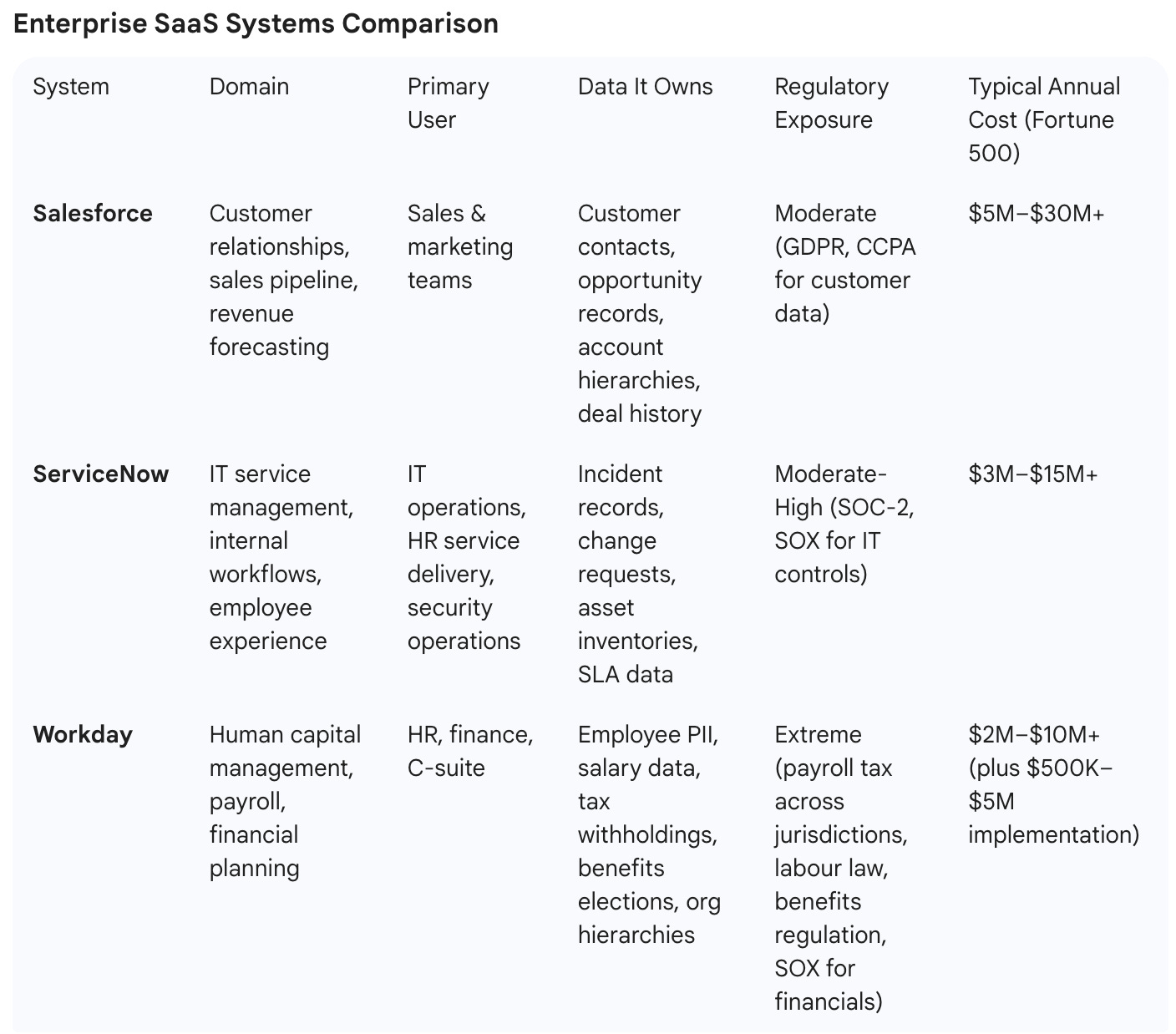
These numbers deserve context. The licence fees are only the visible portion. A Workday implementation for a large enterprise routinely costs 100% of the annual software fees as a one-time charge, meaning a company paying $5 million a year for Workday likely spent another $5 million just to turn it on. Salesforce deployments at scale involve armies of consultants from Deloitte and Accenture. ServiceNow multi-module rollouts run $1.2 million to $4.5 million in services alone, on top of licensing.
But the truly important number isn’t the cost of buying these systems. It’s the cost of connecting them.
The Integration Tax
Here is the fact that determines everything about this story: these three systems do not naturally communicate.
A new employee joins the company. Workday creates their record. But ServiceNow needs to know about this person too - to provision their laptop, set up their email, grant building access. And Salesforce might need to know as well, if this person will be handling customer accounts. One person being hired triggers workflows across all three platforms simultaneously.
Now multiply that by every business process in a Fortune 500 company. Employee promotion? Workday adjusts salary, ServiceNow updates access permissions, Salesforce may reassign accounts. Customer escalation? Salesforce logs the complaint, ServiceNow routes the technical ticket, and if it’s bad enough, Workday’s absence management system might get involved when the account manager takes stress leave.
The integration is typically handled by middleware - MuleSoft (owned by Salesforce), Workato, Boomi, or custom-built API connectors. A mature Workday deployment alone has 200 to 400 integrations: bank files for payroll, benefits carriers, 401(k) (as well as the UK equivalent pension scheme for their London office) providers, tax agencies, background check vendors, ATS systems, learning platforms. Each with its own file format, authentication method, error handling, and reconciliation process. Industry research suggests integration work consumes 20–35% of total implementation budgets. For a Fortune 500 company running all three platforms, the annual cost of just keeping the plumbing working between them can exceed the licence fee of any individual system.
This is the terrain. Three kingdoms, three commercial relationships, three support contracts, three upgrade cycles, and an invisible web of integrations holding it all together with varying degrees of duct tape.
Now look at Frontier.
Reading the Blueprint
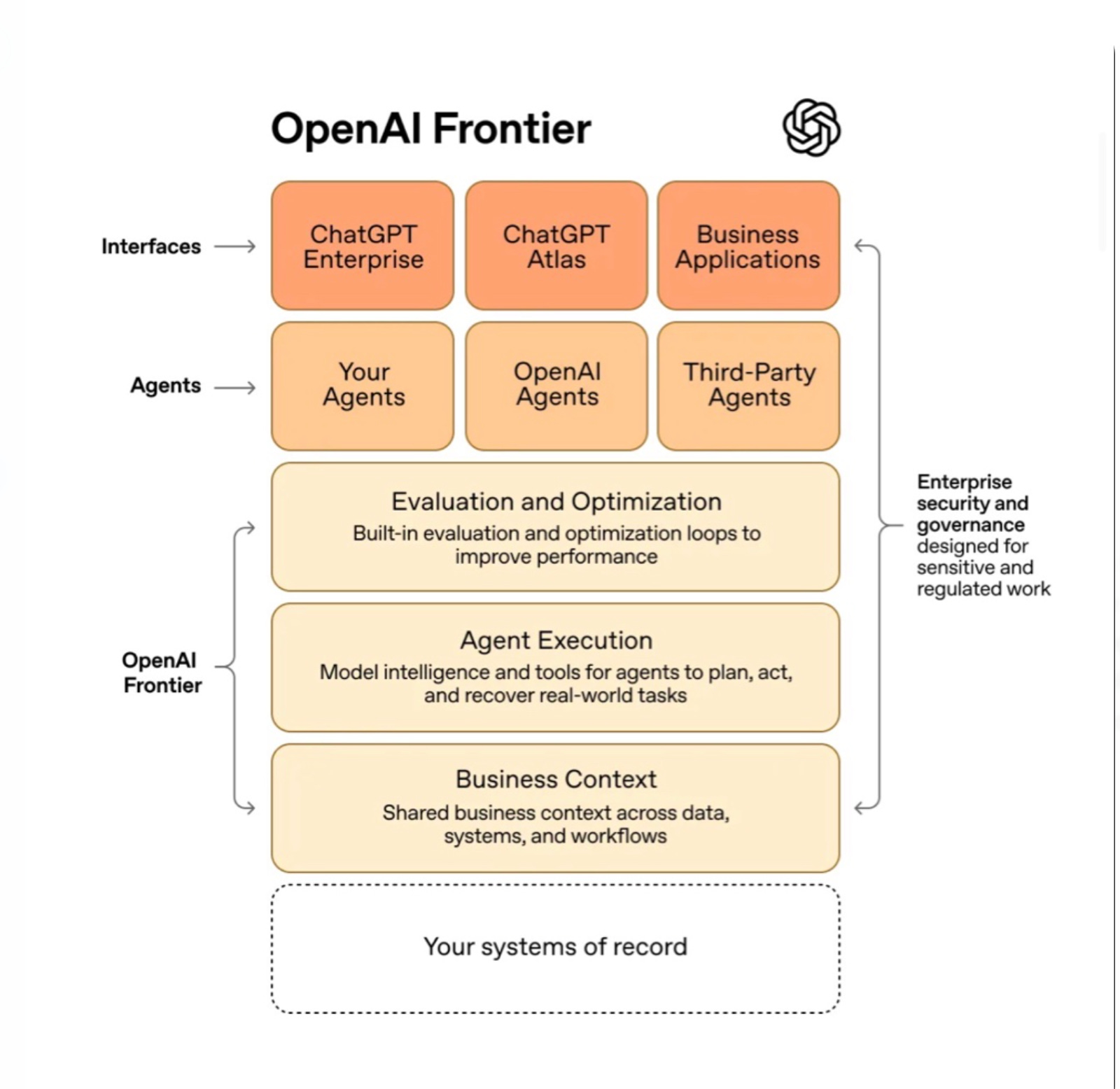
OpenAI’s Frontier architecture has five layers. From the bottom up:
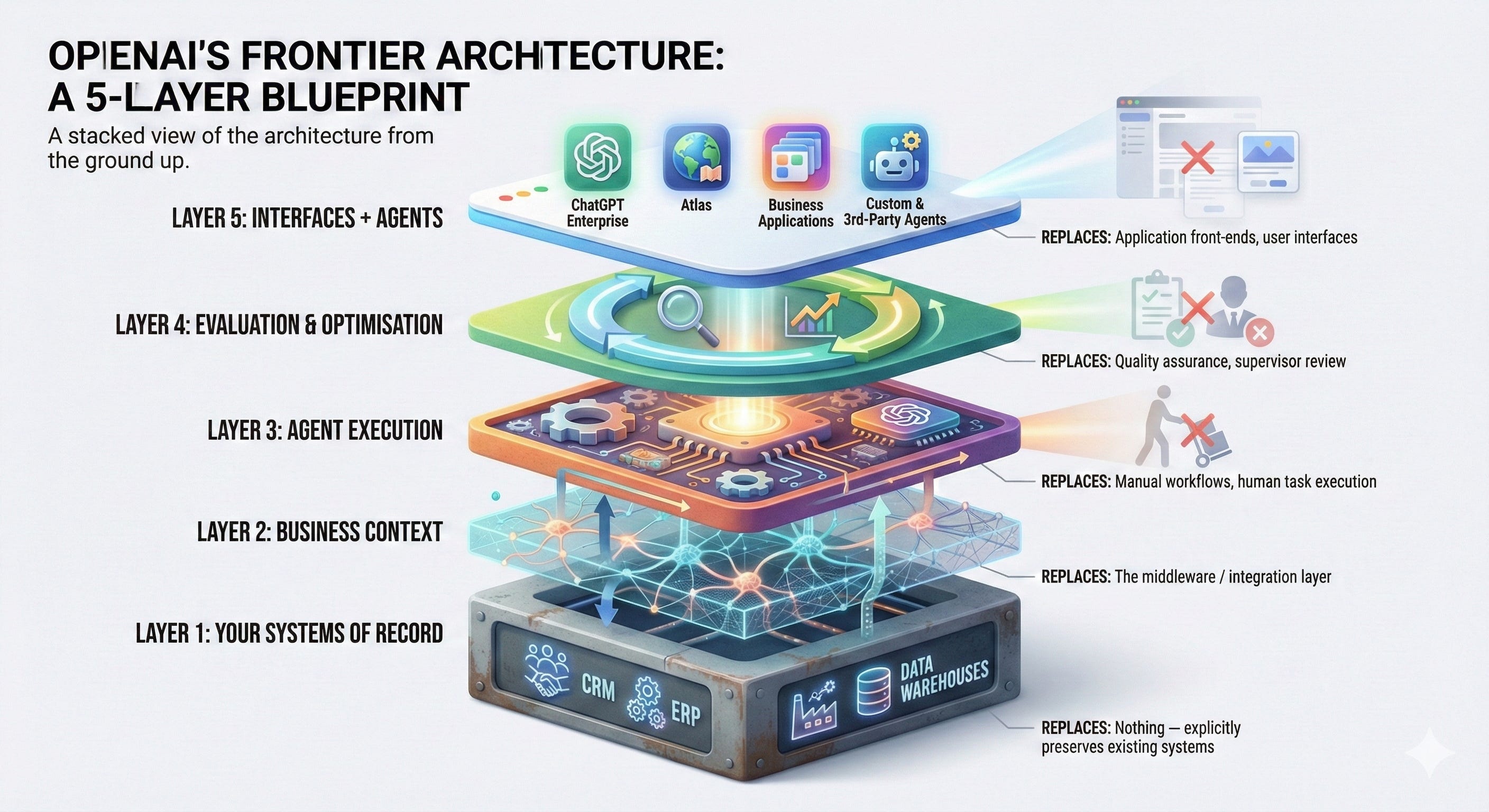
The most revealing detail is at the very bottom: a dashed box labelled “Your systems of record.” Not our systems. Yours.
OpenAI is not proposing to replace Salesforce, ServiceNow, or Workday. Not explicitly. The pitch is more subtle. Frontier positions itself as the intelligence layer that sits on top of everything - it reads from your CRM, your ticketing system, your HR platform, builds a unified understanding of how information flows, and then deploys AI agents that act across all of those systems simultaneously.
Which raises the question every investor in enterprise SaaS should be asking: if the intelligence sits above the software, and the user relationship moves to the agent, what exactly are you paying Salesforce $165 per seat per month for?
The Moat Line
To answer that, you need to draw a line through the middle of the Frontier stack diagram.
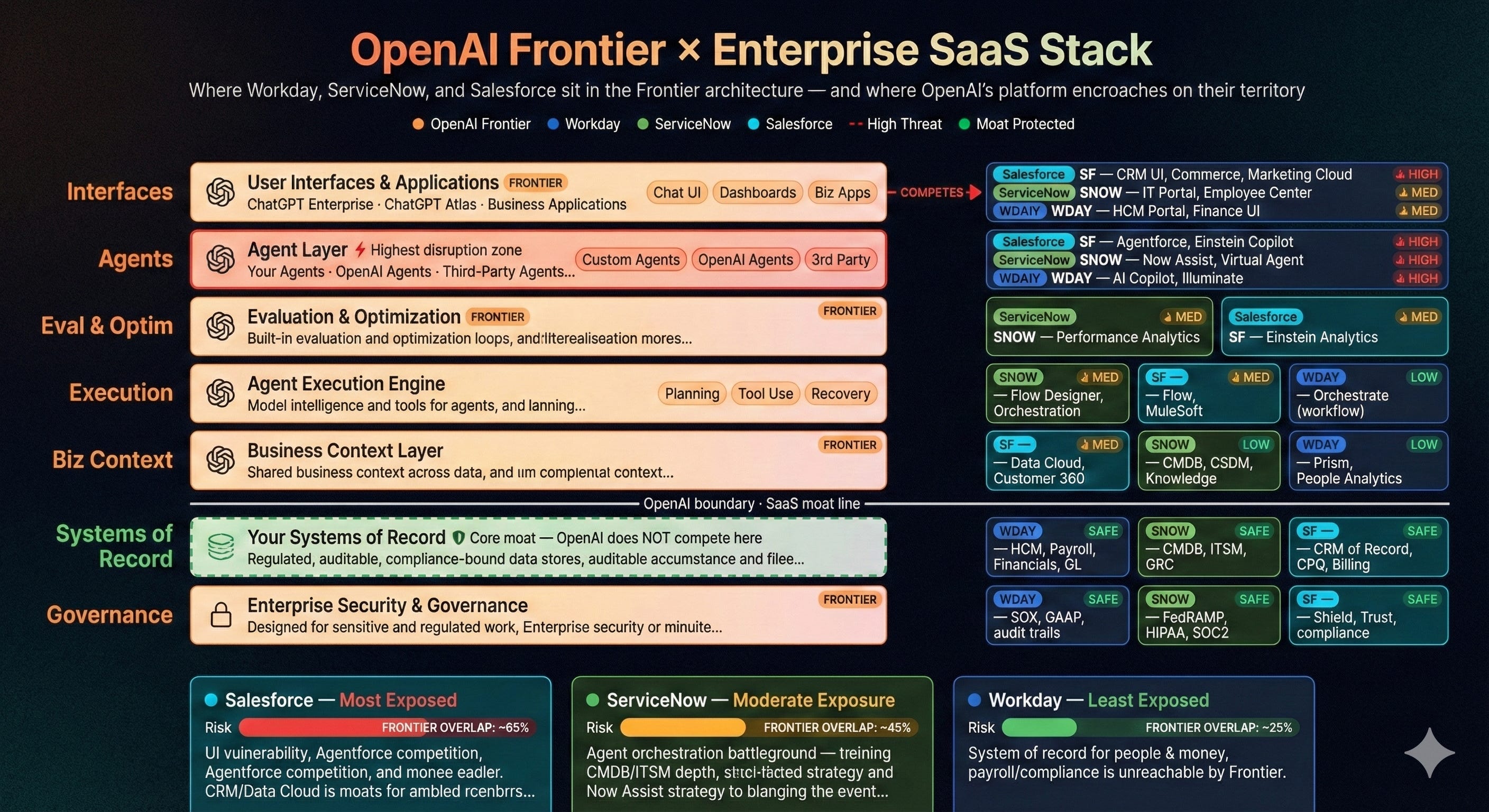
Above the line sits everything Frontier can credibly absorb: the user interface, the agent logic, the workflow orchestration, the cross-system search and analytics. Below the line sits everything it cannot: the regulated data stores, the compliance engines, the deterministic business logic that has been configured over years, the legal liability that comes with running payroll or filing financial statements.
When you map the three SaaS providers against this line, the threat exposure is not uniform. It’s not even close.
Salesforce: ~65% Exposed
Salesforce is the most vulnerable because its core value proposition sits almost entirely above the moat line. The CRM interface, the sales workflows, the lead scoring, the pipeline dashboards - these are exactly the kind of functions an AI agent can absorb. The customer data itself belongs to the customer, not Salesforce. An AI agent with access to email, calendar, and communication history can reconstruct most of what lives in Salesforce. And critically, nobody is going to prison because they migrated from Salesforce to HubSpot. The compliance exposure is the lightest of the three.
Salesforce knows this. Its defensive move has been Data Cloud - the bet that if they can become the data gravity centre for customer information, they can hold the relationship even if the UI shifts to an agent. Agentforce is the other play: own the agent layer yourself before OpenAI commoditises it. But the pricing chaos tells you how that’s going. Three pricing models in eighteen months - $2 per conversation, then Flex Credits at $0.10 per action, then back to per-seat at $125/user/month via the Agentic Enterprise Licence Agreement. Internally, Salesforce deployed Agentforce to handle 380,000 customer support interactions, with 84% resolved without human involvement. Across 90 enterprise accounts, one Salesforce sales engineer reported a 10% reduction in human seats.
The company that historically “just doesn’t discount ever” was suddenly offering steep discounts to get enterprises committed. That is the sound of a business model trying to find its new floor.
ServiceNow: ~45% Exposed
ServiceNow faces real competition in L1 support automation and basic ticketing - Frontier agents can handle “reset my password” flows perfectly well. But ServiceNow’s CMDB (Configuration Management Database), its GRC (Governance, Risk, and Compliance) module, and its deep ITSM configuration are essentially unreachable from the Frontier layer. In regulated industries - banking, healthcare, government - ServiceNow becomes the system of record for audit trails, change management compliance, and security incident documentation. SOC-2, FedRAMP, ITAR: these certifications took years to earn and cannot be replicated by a context layer.
ServiceNow’s response has been to partner aggressively. In January 2026, it signed a three-year deal with OpenAI to integrate GPT-5.2 into its platform - essentially inviting the threat inside the castle walls and hoping to control it. Its AI Control Tower product is a bet that enterprises will need a governance layer to manage the growing fleet of AI agents across their operations, and ServiceNow wants to be the one providing it.
Workday: ~25% Exposed
Workday is the least exposed, and the reason is simple: nobody is going to let an AI agent be the payroll system.
When you run payroll for 50,000 employees across 30 countries, you cannot have a system that’s right 99.7% of the time. You need a system that’s right 100% of the time, every time, with an auditable trail showing exactly why each calculation happened. Workday’s payroll engine isn’t “smart” - it’s a rules engine with millions of configured tax tables, union rules, benefit deductions, garnishment calculations, and jurisdiction-specific logic. An AI agent doesn’t replace that. To replicate it, you’d need to contain all of that deterministic logic, at which point you’ve just rebuilt Workday.
Workday’s copilot features face some competitive pressure from the Frontier interface layer. But the core business, system of record for people and money, sits entirely below the moat line.
What Would Replacement Actually Require?
Let’s stress-test the thesis. Assume an aggressive CTO at a Fortune 500 company wakes up tomorrow and says: “We’re going all-in on Frontier. Rip out the SaaS stack. Build the future.”
Here is what that project actually looks like, just using Workday alone as an example:
Step 1: Rebuild the data model. Workday’s HCM alone has a deeply relational object model - worker, position, supervisory organisation, compensation plan, benefit plan, pay group, pay component, earning, deduction - all with effective-dated history. Every field has security rules governing who can see and edit it. You’d need to replicate this entire schema in whatever Frontier’s persistence layer is. OpenAI doesn’t offer one today. So you’re either building a custom database (congratulations, you’re now a software company) or you’re plugging Frontier into... another SaaS system.
Step 2: Replicate compliance logic. Workday handles SOX controls for financial close, GAAP/IFRS reporting standards, multi-country payroll tax compliance that changes quarterly, ACA reporting, EEO-1 filing, GDPR data residency requirements, and dozens of other regulatory frameworks. Each of these has been built and maintained by hundreds of Workday engineers over 15-plus years.
Step 3: Rebuild integrations. Those 200 to 400 integrations per platform - bank files, benefits carriers, tax agencies, each with their own file format and reconciliation process - need to be rebuilt from scratch.
Step 4: Survive an audit. When your external auditors arrive, they need segregation of duties, approval chains, change logs showing who modified what and when, and deterministic reproducibility of every financial transaction. “The AI decided to” is not an acceptable audit response. SOX compliance requires that your financial systems produce identical outputs given identical inputs, with full traceability. A probabilistic AI system fundamentally cannot satisfy this today.
Step 5: Accept liability. When Workday miscalculates payroll, Workday has contractual liability and E&O insurance. When your custom Frontier-based system miscalculates payroll across three countries, you own that liability. No enterprise legal team is signing off on this.
The realistic migration path collapses into three options, none of them easy: the AI company takes on the operational burden (becoming a payroll processor, low-margin work they don’t want), the enterprise builds its own (they tried this in the on-prem era and it’s literally why Workday exists), or they switch to a competitor (ordinary competitive pressure, not AI disruption).
The Blank Page Problem
There is another wrinkle the Frontier bulls haven’t addressed, and it’s almost comically simple.
Enterprise software is boring on purpose. The Salesforce dashboard that shows you “My Leads” and “Open Opportunities” in a structured table isn’t just a design choice. It’s solving what psychologists call the recognition-versus-recall problem. A structured menu tells you what’s possible. A blank chat window requires you to remember what to ask.
If you stare at a blinking cursor in ChatGPT Enterprise, you might not know that Salesforce has a feature called “Opportunity Scoring.” If you don’t know it exists, you can’t ask for it. But a Salesforce dashboard puts a button labelled “Opportunity Scoring” right in front of you. The “boring” interface is doing work that the “intelligent” interface cannot.
This matters more than it seems. OpenAI’s answer is something called “Generative UI” - the idea that the agent renders a temporary, purpose-built interface in response to your query. Ask “show me bonuses” and instead of a wall of text, you get a sortable table. It’s elegant in theory. In practice, it means OpenAI needs to build a UI rendering engine that can replicate the specific data presentations of every enterprise application it’s wrapping. That is a very large number of screens.
The more likely near-term outcome is the “copilot” pattern: the SaaS application keeps its structured interface for scanning and navigation, while the AI provides a side panel for querying and executing. The user looks at a Workday screen but talks to the Frontier layer to manipulate it. In this model, both layers survive - but who captures the value?
The Bloomberg Test
There is a framework for evaluating data assets that asks a single question: Can this data be obtained, licensed, or synthesised by someone else? If no, the moat holds. If yes, you’re in trouble. Bloomberg’s real-time pricing data from trading desks can’t be scraped, can’t be synthesised, and can’t be licensed from a third party. In an AI world, that data becomes more valuable, not less - it’s the scarce input every agent needs.
None of the three enterprise SaaS companies pass this test.
Salesforce’s core CRM data - contacts, opportunities, activity logs - belongs to the customer, not Salesforce. An AI agent with access to a company’s email and calendar could reconstruct most of it. ServiceNow accumulates enormous volumes of incident resolution data across thousands of enterprises - there’s a network-knowledge effect - but it’s aggregated customer data, not proprietary ServiceNow data. Workday’s compensation benchmarking products get closest to genuine proprietary intelligence, but ADP has similar or better payroll data. The moat is real but not exclusive.
Under the Bloomberg framework, all three sit in an uncomfortable middle ground: valuable aggregated data derived from customer inputs, not proprietary to the vendor. This means the proprietary-data defence, the strongest possible argument against AI displacement, is not available to them.
But the regulatory-compliance defence absolutely is. And that’s the one that matters.
The Argument Nobody Wants to Make
Here is the honest, uncomfortable, structurally correct argument - and it has nothing to do with AI:
The competitive threat to Workday has always been SAP, Oracle, ADP, and Ceridian. The competitive threat to ServiceNow has always been BMC, Jira, and Freshworks. Salesforce has had Microsoft Dynamics, HubSpot, and Zoho breathing down its neck for years. And yet switching rates remain remarkably low. The moats held. Not because there weren’t alternatives - there always were - but because the cost and risk of migration dwarfs the incremental benefit of a better product.
Does AI change the magnitude of competitive advantage enough to overcome switching costs that have held firm for a decade? If a 20% better product wasn’t enough to trigger migration before, is a 20% better product with an AI copilot enough now?
Probably not. At least not for the installed base.
Where it gets interesting is on the new-customer front. Every year, companies outgrow their existing systems, go through M&A, or expand internationally. That’s where competitive dynamics play out. AI could matter there, if a newer entrant offers dramatically faster implementation or a fundamentally different user experience for greenfield deployments. But that’s normal competitive dynamics with a new technology vector. It’s not structurally different from when cloud-native was the wedge Workday used against on-prem SAP and Oracle fifteen years ago. The incumbents absorbed the threat, adapted, and kept most of their base.
The AI narrative treats this as a discontinuity. The actual evidence suggests it’s a continuation.
The Conditional Buy
For investors evaluating these three names, the question is not “Will Frontier kill SaaS?” The answer to that is almost certainly no - not in 2026, and probably not in 2027.
The question is: Where does the value accrue?
The bear case isn’t that Frontier replaces the incumbents. It’s that Frontier commoditises their AI premium, forcing them to compete on core platform value rather than charging extra for AI features. That’s a margin compression story, not an existential one. It looks like this:
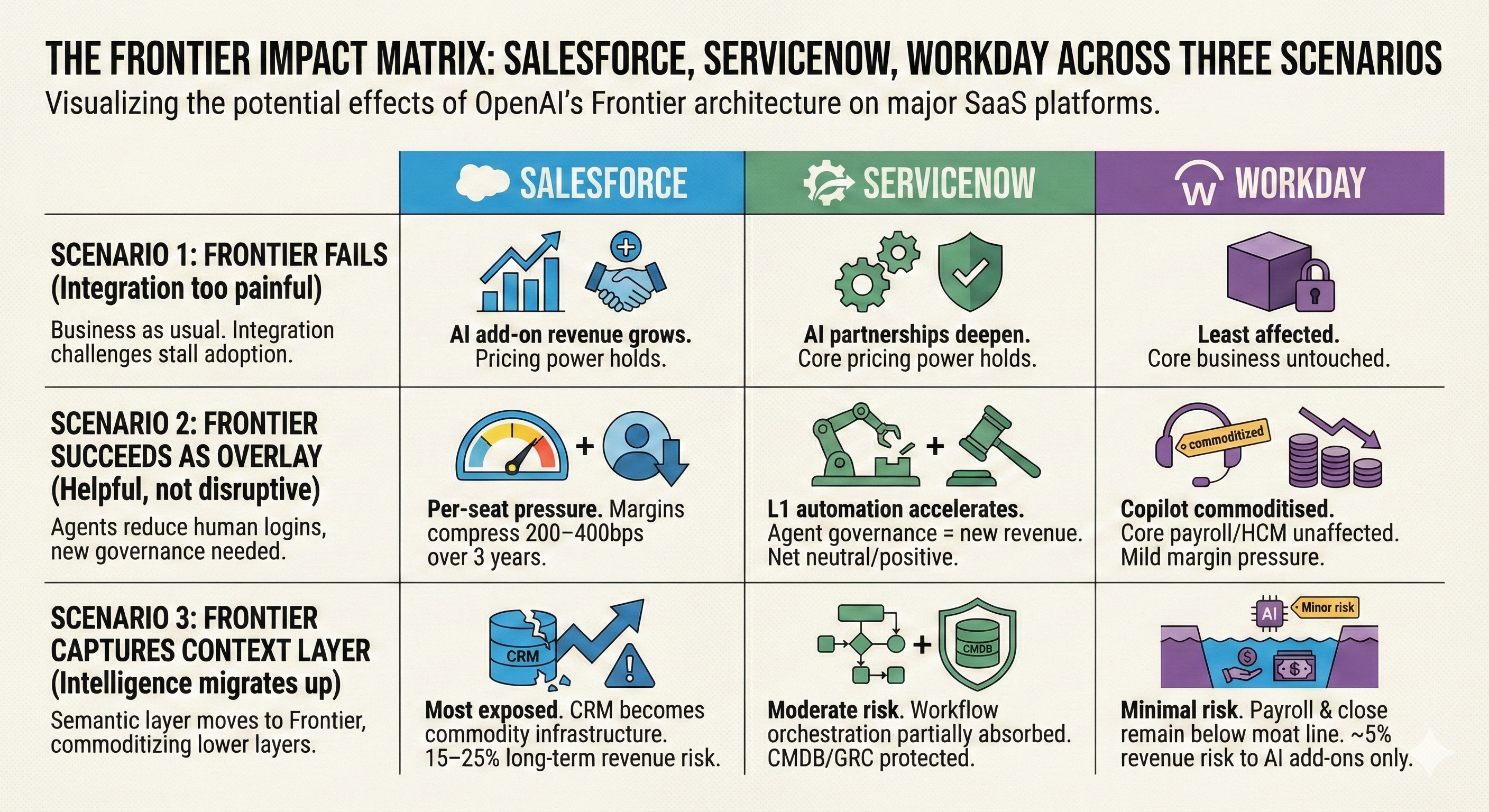
The specific trigger to watch: Frontier’s first public case study showing measurable reduction in middleware and integration spending at a Fortune 500 company. That is the moment the narrative shifts from “helpful overlay” to “platform risk.” Until that case study exists, the incumbents have the benefit of the doubt.
If you’re forced to rank the three by resilience: Workday first, ServiceNow second, Salesforce third. The ordering isn’t close. The company with the most boring product has the strongest position - precisely because it’s boring. Payroll tax compliance doesn’t make for a good demo. But it makes for a very good moat.
The Layer That Matters
Fidji Simo’s dream at Instacart was simple: one platform where everything talks to everything else. The reason she couldn’t achieve it then is the reason it’s so hard now. Enterprise software isn’t a collection of applications. It’s a collection of commitments - legal, regulatory, contractual, and organisational. Each system represents not just a technology choice but a decision about who is responsible when things go wrong.
OpenAI’s Frontier is a brilliant architectural diagram. It may even be a brilliant product. But there is a line drawn across the middle of that diagram, and everything interesting about the investment thesis depends on which side of it you’re standing on.
Above the line, the value is migrating. Below the line, it’s staying put.
The question was never whether you could build a unified intelligence layer across Salesforce, ServiceNow, and Workday. The question is whether a Fortune 500 board will vote to let you try - and whether, once you do, anyone actually wants to type their business questions into a blank white box when there’s a perfectly good “Approve Leave” button right there on the screen.
After all, you can’t sue a blinking cursor either.