
Chasing Elon: How Rivian and Lucid Stack Up Against Tesla’s 2018 Nightmare
The Electric Hangover: A Tale of Two Survivors and the Ghost of Elon Past

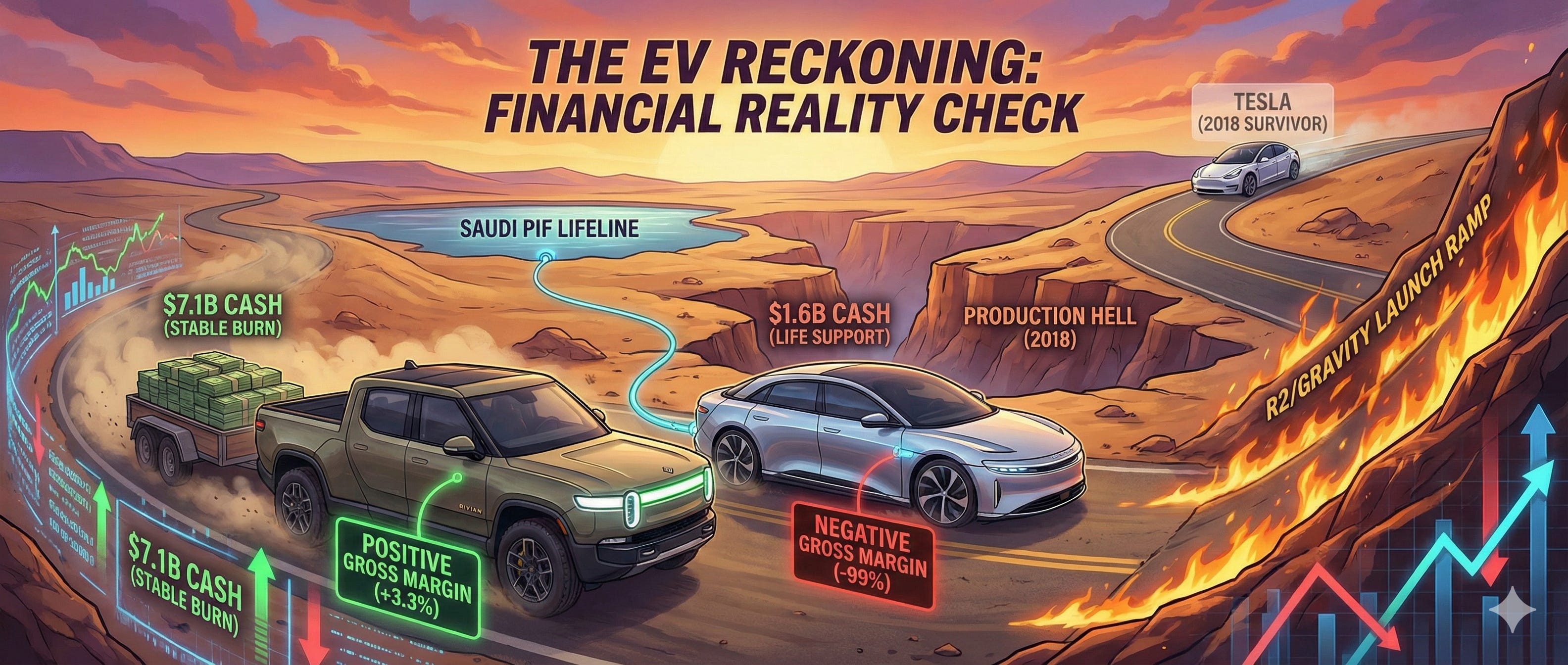
The party is over. The confetti from the SPAC boom has been swept away, the cheap money has evaporated, and the electric vehicle industry has woken up with a splitting headache. A few years ago, all you needed was a slide deck and a rendering of a futuristic door handle to be worth billions. Today, you need to actually build cars, which, as it turns out, is a terrible way to make money.
In the wreckage of the “Next Tesla” sweepstakes, two names are still standing, blinking in the harsh light of reality: Rivian and Lucid. Both promised to out-design, out-engineer, and out-class the erratic genius of Elon Musk. But as we look at the balance sheets in 2026, the story isn’t about who will catch Tesla. It’s about who survives the night.
To understand the stakes, you have to look at the numbers. They don’t lie, even if the CEOs sometimes might.
The Boy Scout: Rivian’s High-Stakes Camping Trip
If Tesla is the chaotic, tweet-storming wild child of the auto world, Rivian is the Eagle Scout. Based in Normal, Illinois—a town name so perfect a novelist would have rejected it for being too on-the-nose—Rivian is earnest, outdoorsy, and burning cash with a disciplined intensity.
RJ Scaringe, Rivian’s founder, isn’t sleeping on the factory floor in a sleeping bag—or at least, he’s not tweeting about it. He has built a brand that people genuinely love. The R1T truck is a marvel. But the financials tell a story of a company walking a tightrope over a canyon.
Rivian Financial Reality (The “Normal” Operations)
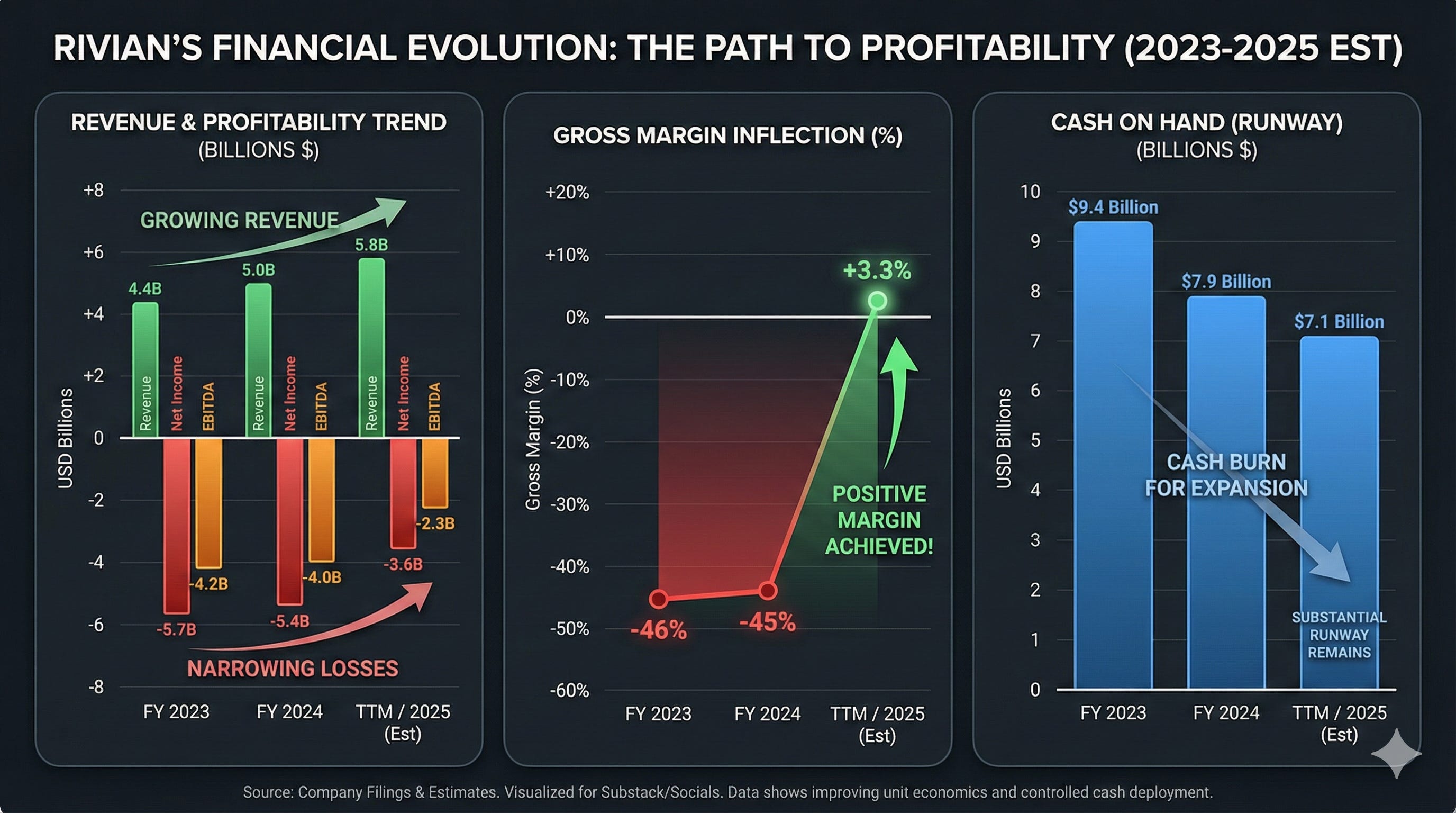
Rivian is sitting on a pile of cash - about $7.1 billion. In any other industry, that’s a war chest. In the auto industry, it’s a packed lunch. They are currently losing money on every truck, though they’ve finally stopped selling dollar bills for ninety cents. They posted a positive gross margin recently, a meager few percent, which in this business counts as a Herculean triumph.
But here is the rub: Rivian is betting the farm on the R2, their mass-market SUV launching in 2026. It’s the same play Musk made with the Model 3. But when Tesla was in its “production hell” in 2018, it was growing like a weed. Rivian is safer, richer, but slower. They have the cash to survive the launch, but they lack the manic, escape-velocity growth that allowed Tesla to outrun its mistakes.
The Gilded Cage: Lucid’s Saudi Lifeline
Then there is Lucid. If Rivian is a business trying to prove it can work, Lucid is a science experiment trying to prove it’s a business.
Peter Rawlinson, the engineer behind the Tesla Model S, built the Lucid Air to be the best electric car in the world. And he arguably succeeded. It is faster, more efficient, and more technically brilliant than anything Musk has put on the road.
There is just one problem: nobody is buying enough of them.
Lucid Financial Reality (The Cash Incinerator)
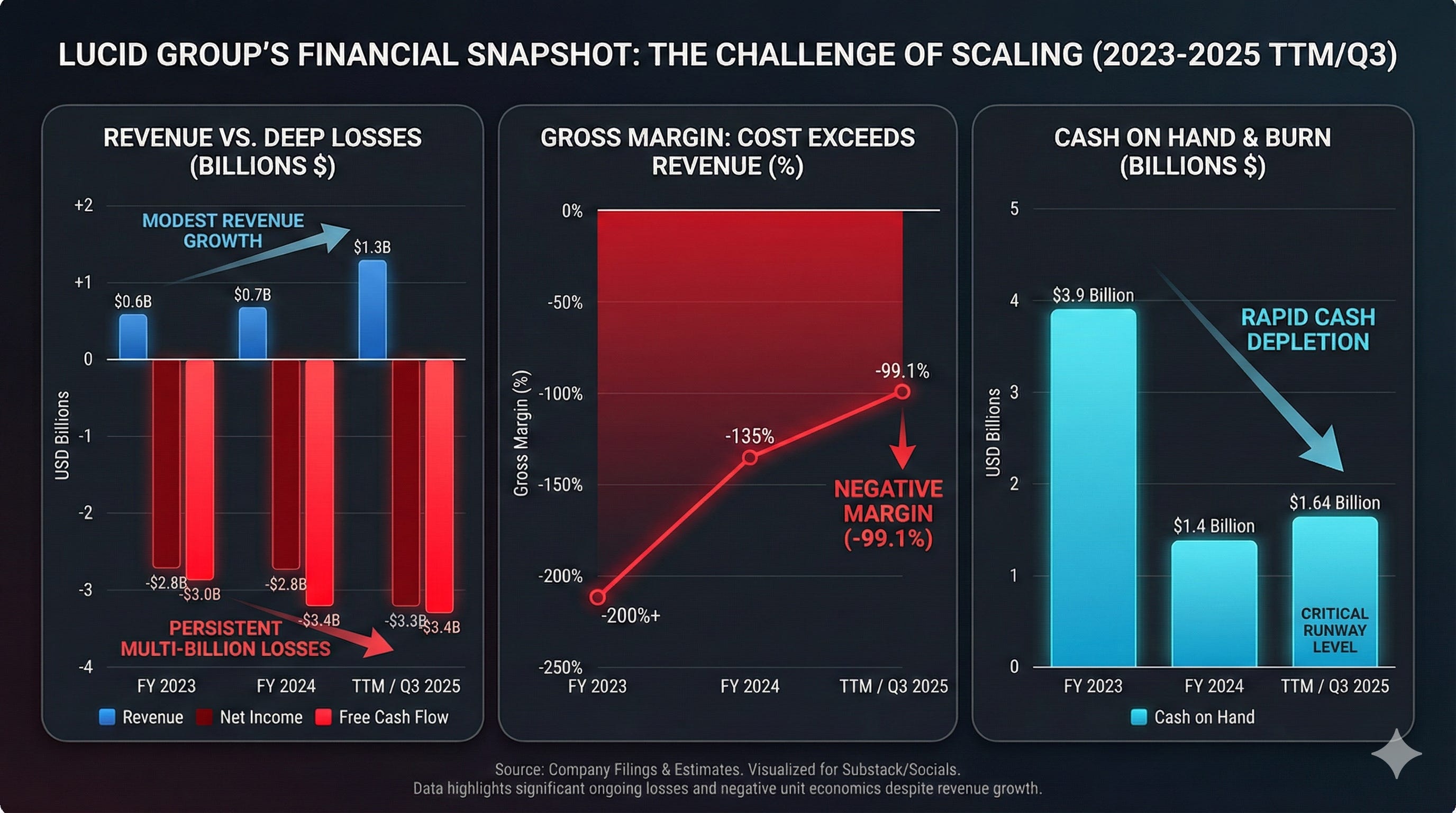
Lucid’s financials are the stuff of nightmares. Look at that gross margin: -99.1%. That means for every $100,000 car they sell, it costs them roughly $200,000 just to screw the parts together. That’s not a business; that’s a charity for rich drivers.
So why is the company still alive? Because it has a rich uncle. The Saudi Public Investment Fund (PIF) owns about 60% of the company. Every time Lucid runs out of cash, which happens with clockwork regularity, the Saudis write another check. Lucid has become a zombie: too rich to die, too unprofitable to live.
The Comparison: The Ghost of 2018
To understand the sheer cliff these companies are climbing, you have to look back at Tesla in early 2018. That was the moment the whole enterprise nearly imploded. Elon Musk was firing people, sleeping in conference rooms, and building assembly lines under tents in the parking lot.
We ran the numbers to see how the current crop of contenders stacks up against the Champion when he was on the ropes.
The “Survival” Matrix: Rivian vs. Lucid vs. Early Tesla
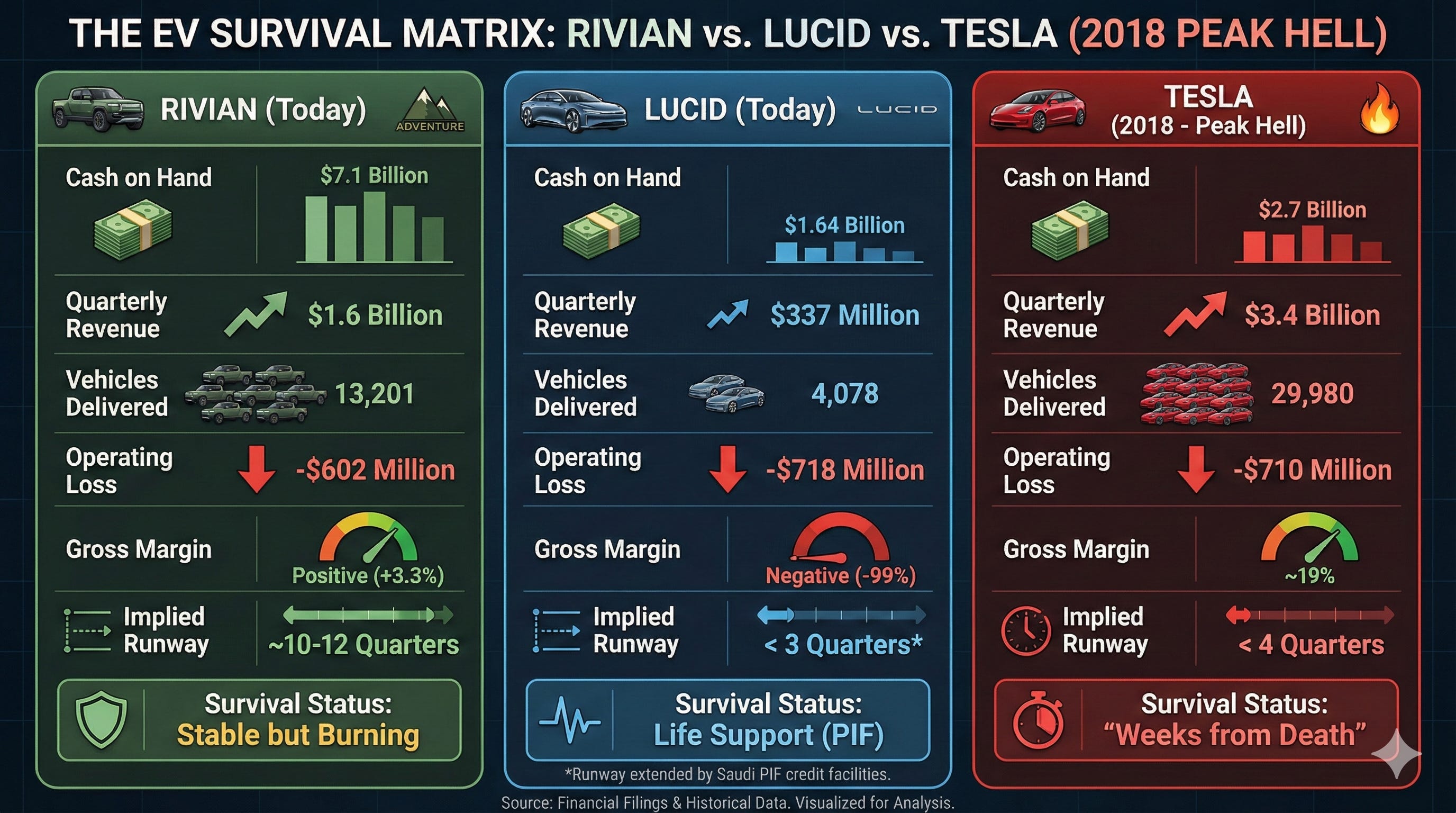
Note: Lucid’s runway is artificially extended by Saudi credit facilities. Obviously Tesla survived being week's from death, but at the time it felt real.
The difference jumps off the page. In 2018, Tesla was arguably “one month from bankruptcy,” but it was generating $3.4 billion in quarterly revenue—double what Rivian is doing today. Tesla’s “hell” was chaotic, but the demand was ferocious.
Rivian is in a different boat. It has significantly more cash ($7.1 billion) than Tesla did, so the risk of immediate death is lower. But it doesn’t have the explosive growth. It’s a marathon runner trying to sprint, whereas Tesla was a sprinter trying not to have a heart attack.
The Verdict
For Rivian to reach “Tesla Heights,” it doesn’t need a miracle; it needs perfect execution. It needs the R2 to launch on time, under budget, and sell like hotcakes. The $7 billion cushion gives them one shot. If they miss, they are just another cautionary tale.
For Lucid, the path is darker. Unless they can convince the world to buy hundreds of thousands of ultra-luxury sedans, or their new Gravity SUV performs a miracle, they are destined to remain a ward of the state, a beautiful, high-tech ornament in a sovereign wealth fund’s portfolio.
The lesson of the EV boom is brutal but simple: It is easy to simulate the future. It is incredibly hard to manufacture it at a profit.